
Stop Accidentally Suggesting Dates that Suck (Part 2)
What kinds of dates are people designing today, and how could they do better?

In Part 1 of this series, I covered the basic anatomy of a date that doesn’t suck, along with several examples. Here in Part 2, I explore the most common kinds of dates I’ve witnessed people proffer in 15 years of dating / coaching / industry research, and why those dates frequently lead to failure, flaking, and burnout.
The basic function of dating is to evaluate whether you and someone else can happily co-exist for an extended period. After all, for many relationships, you might be spending hours each day together, or living together for months on end. A well-designed date can suss out multiple dimensions of compatibility, and help you uncover how each of you show up across different scenes and through different physical and emotional states.
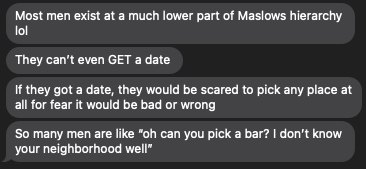
Unfortunately, most people still default to dinner, drinks, and/or movies as their go-to first date suggestion, and many fail to even suggest a specific venue, thereby making themselves seem lazy, avoidant, or logistically inept — a surefire way to get rejected or ghosted. An NYC-based woman who’s been on over 400 dates recently remarked,
We can do so much better. Let’s explore the styles of date design I most frequently encounter, and how they can be improved.

Minimalist date design
Date design minimalists are the ones who religiously suggest a coffee walk-and-talk date, or who insist upon the same bar every time to every suitor. For them, this feels efficient and relatively safe. They know the bartender, drinks are cheap, and it's close by, so the cost of a bad date is fairly minimal.
The downside of this level of minimalism is that it can rapidly induce burnout. If you end up doing the same bar date with dozens of people, it can start to feel like a slog. When you anticipate things being formulaic and uninspiring, it will show in your affect and demeanor, so you run the risk of becoming a less interesting, more judgmental version of yourself with each subsequent date because you’re allowing minimal space for variation or vulnerability.
Maximalist date design
You can spot a date design maximalist from a mile away. They prefer things like exclusive reservations, private chefs, international weekend getaways, and other grandiose gestures that typically showcase either wealth, commitment capacity, or refined taste.
While plenty of people love being on the receiving end of copious romantic attention and pre-planned lavish splendor, this approach to date design is about as risky as it gets, because as expectations grow, so do the risks of incompatibility. Imagine your suitor invites you to a $600/person restaurant for your first date, but then you get held up at work and can’t make it on time. Or imagine they spent $1000 on your date and then (god forbid) you don’t want to sleep with them and they get pouty about it. Or if you committed to a weekend getaway with them as a first date, and you discover as you’re boarding a flight together that they’ve already got a spouse, two kids, and a labradoodle that they conveniently never mentioned.
While there’s nothing inherently wrong with buttering life to the edges and opting for a genuinely memorable experience, I still believe that if you’re not designing your date specifically for eliciting compatibility, you run the risk of the misaligned expectations, premature over-investment, and a general lack of vulnerability.
Outsourced date design
Those who outsource date design tend to do one of two things: either they go through friends or paid matchmakers who set them up on dates and handle all the logistics for them, or they venture out to speed dating events or group dates where the organizers/venues set the candor of the evening.
It can be nice to have someone else deal with the overhead of cultivating a good dating experience/environment, especially if you don’t yet have much experience planning creative dates, but I see two key drawbacks. First, you’re beholden to someone else’s idea of what an encounter should look and feel like, so you’re implicitly boxed into a specific venue, run-of-show, or set of someone else’s expectations who is not the person you’re on a date with.
The second drawback is that you skip that critical phase of co-creation with your suitor, where you would tap into one another’s preferences, local knowledge, life logistics, and creativity. In virtually any long-term relationship, you’ll both be relying on one another nearly every day to creatively negotiate these logistics, so it’s best to discern as early as possible how well you can navigate this practice together.
Collaborative date design
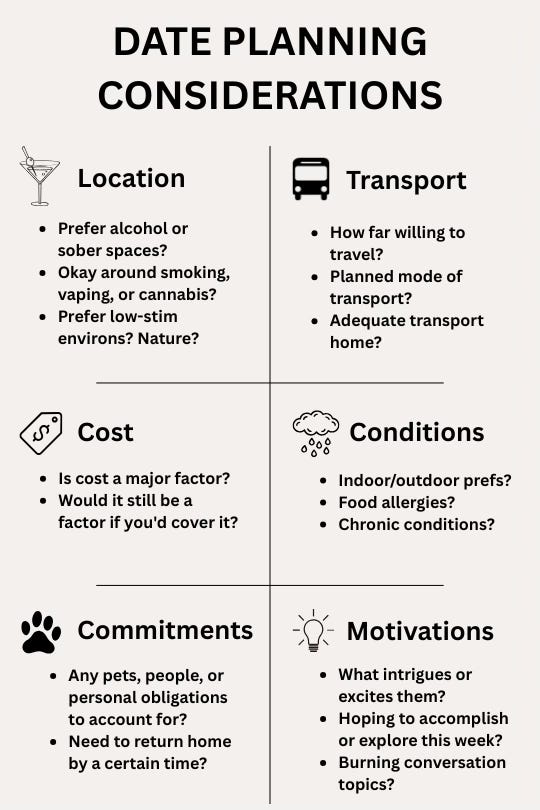
It’s hard to overstate how many things we can learn about someone by designing a date together that’s rooted in our shared preferences. Ideally, a dating app or thoughtful matchmaker would solicit dozens of preferences across many dimensions in order to find out if we’re properly compatible, but given that we typically lack this information, it’s on us to come up with creative ways to gather those critical details. Luckily, we can do this at the level of date design!
Here are just some of the preferences we can discover in the course of concocting a date with someone:
Remember, every single person you encounter is bringing their own fears, concerns, and excitements to the table. You’re never alone, here. What’s important is that you create space for all the people you meet to feel comfortable and excited navigating this process with you, even if you don’t turn out to be long-term compatible. Who knows — maybe they won’t be the one for you, but they could happily introduce you to the one (or each of the ones) throughout your life. Compatibility isn’t guaranteed, but friendship, deep connection, and camaraderie are easy wins that can generate multiplier effects throughout your dating journey.
Next Up…
OK, so how do I practically do this? How do I suggest to someone that we design a date together?
Find out in part three of this series! After that, we’ll dig into first date conversations as well as overcoming sexual & romantic expectations!
Need help with dating, personal development, or navigating relationships? Let’s talk! I’ve been a coach and dating app consultant for nearly 15 years! Schedule a call with me and we’ll talk through your life, goals, struggles, and strategy. First call is free, and I’ll do what I can to point you in the right direction!
~Steve
What seems like it should be common sense is not so common. Thanks in particular for outlining these "date planning considerations" that can apply to all types of social get-together collaborative planning beyond dates or the romantic sphere, that hopefully many people see as a reminder of the inequitable infrastructure we inhabit and navigate in the U.S. As you write, "It’s hard to overstate how many things we can learn about someone by designing a date together that’s rooted in our shared preferences." Planning itself is a discovery process indeed, especially for those of us who love to plan experiences and also observe with a bit of healthy detachment the experiences themselves. The red flag of lack of conscientiousness for the other person's comfort and logistics really shows up in transit professionally to me in Metro Detroit where more often than not the person in privilege does not take into consideration or simply does not care the huge energy & stamina involved to get from A to B and back, without a car, in a heat wave. Power differences should not degrade dignity or put safety at risk, contrary to popular mentality. "What’s important is that you create space for all the people you meet to feel comfortable and excited navigating this process with you" -- yes, appreciate your advocating this mutuality and hospitality!